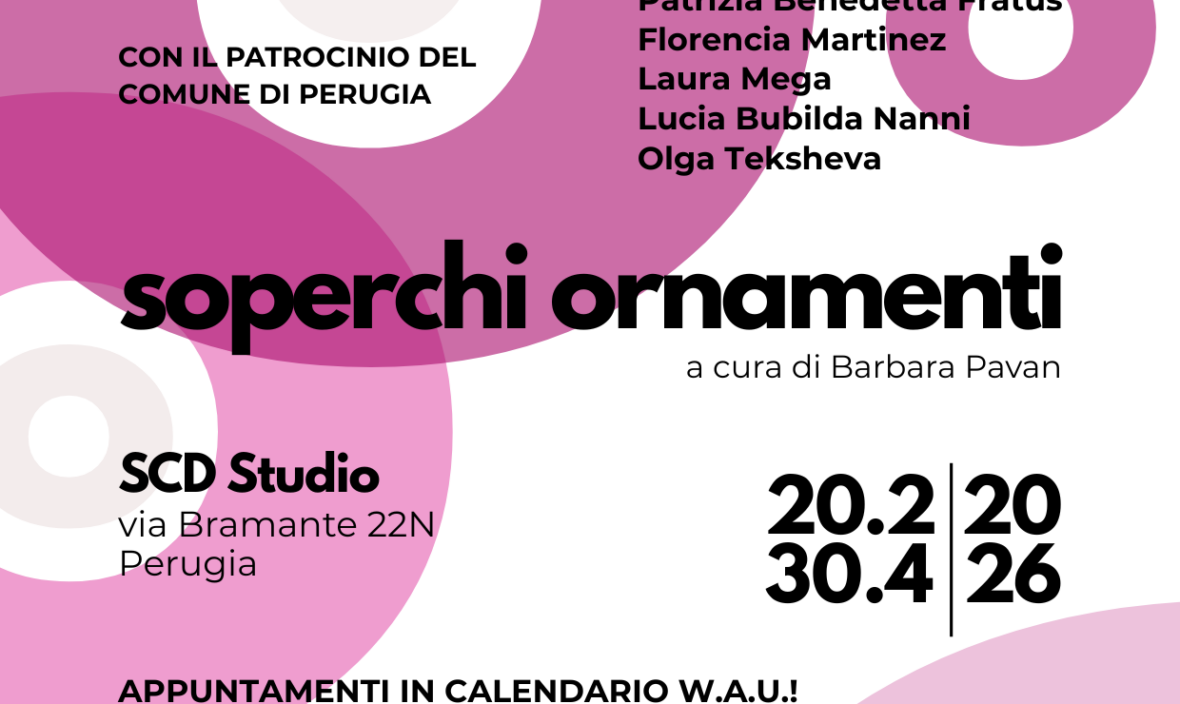
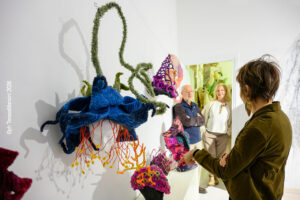
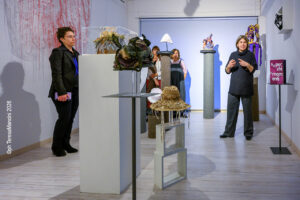
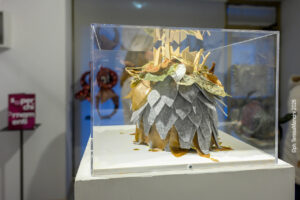
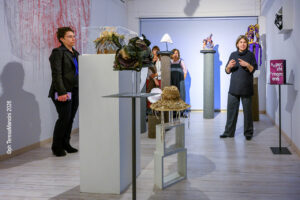
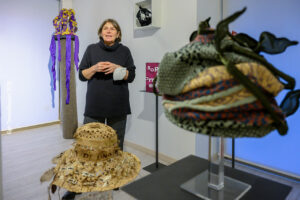
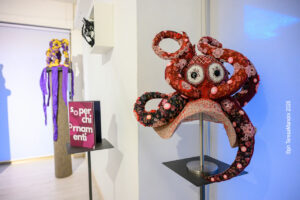
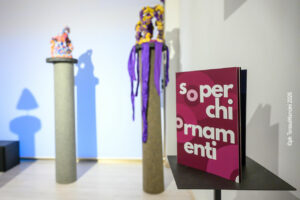
SOPERCHI ORNAMENTI is an exhibition that investigates the headdress as a symbolic, political, and poetic device, traversing centuries of cultural history and offering a reinterpretation through the language of contemporary art. The project takes its cue from the Pauline injunction regarding the covering of women’s heads—an ideological foundation for a long tradition of subordination and control over women’s bodies—in order to overturn its meaning.
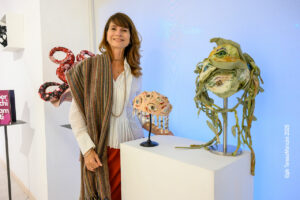
Nine artists, active on both the national and international scene, shape a journey of soft sculptures in the form of headdresses, bringing into dialogue textile practices historically regarded as “minor” because they were associated with women, with an aesthetic and conceptual research that moves beyond any predefined identity or disciplinary boundary. Here, textile becomes a language capable of expressing that distinctive mark of female ingenuity which, within the limits imposed by patriarchal history, has been able to transform constraint into possibility and the boundary into a generative space. The exhibition reinterprets the role of the accessory as an emblematic element of a female creativity capable of allowing other worlds to germinate within circumscribed spaces.
SOPERCHI ORNAMENTI draws on a stratified memory interweaving art, history, and current events, beginning with the medieval use—when, between the thirteenth and fourteenth centuries, women’s covered heads became sites of display and protagonism, to the point of being censured as “soperchi ornamenti” (excessive ornaments)—and moving across the centuries to the white headscarf of the Madres de Plaza de Mayo, a symbol of resistance and justice, and arriving at the recent uprisings of Iranian women, who have transformed the gesture of removing the veil into a revolutionary act. Within this historical and symbolic continuum, the headdress asserts itself as a work of art and a political statement in the broadest and noblest sense of the term: an affirmation of the uniqueness of every individual, a vehicle for ideas, and an instrument of emancipation. SOPERCHI ORNAMENTI proposes an abundant, hybrid, and destabilizing imagery capable of dismantling preconceptions and leading the viewer into a space where predefined roles dissolve and new possible realities take shape. It is a project that celebrates the female gaze as a transformative force, capable of impacting the present and imagining alternative futures.
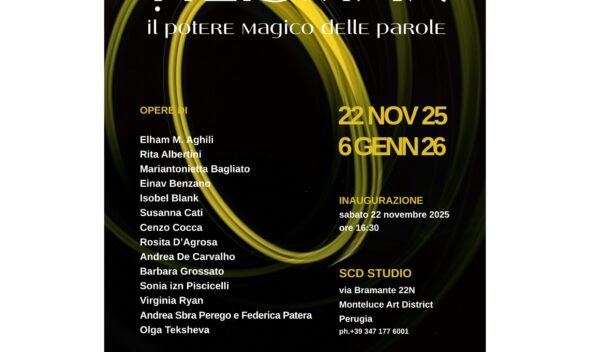
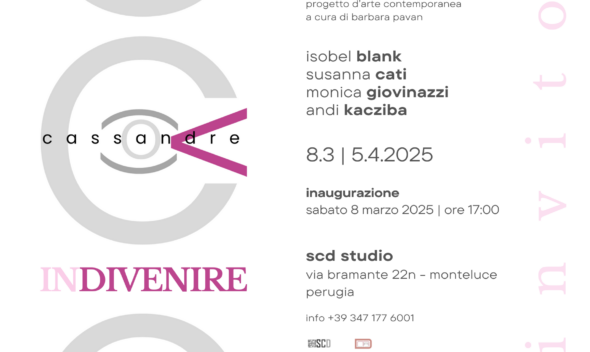
The exhibition project finds in the territory of Perugia a particularly meaningful context, by virtue of its deep historical stratification and the city’s ability to sustain a dialogue between tradition and contemporaneity—fertile ground for a critical reflection on the cultural and social dynamics that traverse women’s experience, also in light of a recent history marked by emblematic figures such as Luisa Spagnoli, whose entrepreneurial, social, and symbolic legacy embodies a model of transformation capable of combining innovation, collective responsibility, and local rootedness. Within this horizon, the project coherently connects with the path initiated by SCD Studio through CASSANDRE, a platform dedicated to contemporary art as a space for investigating the structures of systems of power.
CASSANDRE is an artistic and curatorial project conceived as a platform and critical laboratory which, inspired by the mythological figure of Cassandra—an emblem of lucid truth that is systematically unheard—explores the mechanisms of exclusion, delegitimization, and silencing enacted by patriarchal, institutional, and cultural systems of power. Through events, artworks, and interventions that reinterpret practices historically associated with women’s “making” in a conceptual and experimental key, integrating them with contemporary languages and advanced technologies, the project restores a voice to marginalized perspectives and reflects on the female condition as a space of resistance, self-determination, and conflict. The events proposed within this framework explore the multiple forms of oppression and discrimination still operative in contemporary society, denouncing their structural dimension and inviting the viewer to develop a critical awareness of the contradictions of the present and of the possibility of imagining future transformations.